A 40 ton overhead crane is commonly used in steel fabrication workshops to lift, transfer, position, and assemble heavy steel components throughout the production process. Typical loads include steel plates, welded frames, beams, columns, fabricated structures, machine bases, and finished steel assemblies. In a fabrication workshop, the crane is not used for one isolated lifting task. It often supports multiple stages, from raw material handling and cutting to welding, assembly, inspection, and finished-product dispatch.
The main advantage of a 40 ton overhead crane is its ability to move heavy loads across a defined workshop area without occupying the floor with a mobile lifting machine. Because the crane travels on elevated runways, production equipment, trucks, welding stations, and storage areas can remain available below the crane operating zone.
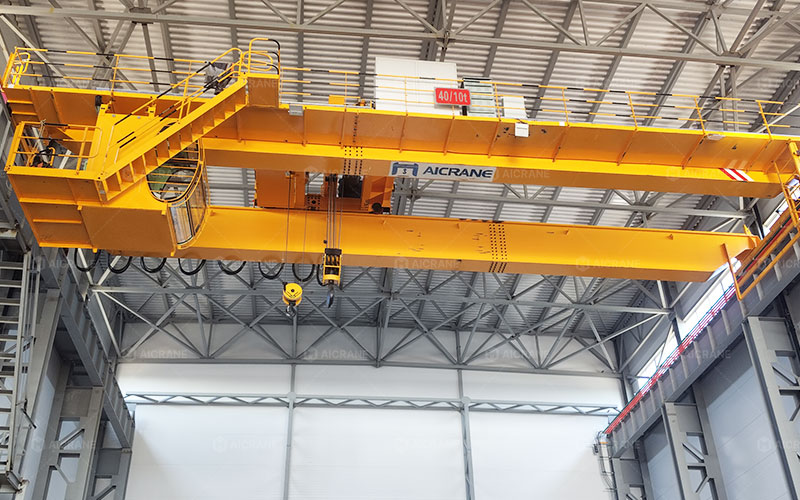
What Does a 40 Ton Overhead Crane Do in a Steel Fabrication Workshop?
Steel fabrication involves many individual handling operations. A steel plate may arrive by truck, move to a cutting station, transfer to a welding area, and eventually become part of a large structural assembly. Each movement can require lifting equipment.
A 40 ton overhead crane can perform tasks such as:
- Unloading heavy steel components from transport equipment
- Moving steel plates between storage and processing areas
- Positioning beams and columns for fabrication
- Turning or repositioning welded assemblies
- Moving large frames between welding stations
- Transferring fabricated structures to inspection areas
- Loading finished steel assemblies for shipment
- Supporting maintenance and replacement of heavy workshop equipment
The overhead crane capacity is only one part of the application. The required span, lifting height, runway length, duty classification, hook approach, lifting speed, and control method must match the workshop layout and production cycle.
Handling Steel Plates and Heavy Raw Materials
One of the first applications is moving steel plates from the storage area to the processing line.
Large plates can weigh several tons individually. When several plates are stacked, forklifts may not be suitable because of the combined weight and plate dimensions. A crane equipped with appropriate lifting devices can pick up individual plates and position them at cutting or processing stations.
For example, assume a fabrication workshop receives a 12-meter-long steel plate weighing 8 tons. The crane does not need to lift 40 tons simply because it is rated for 40 tons. The actual lifting requirement is determined by the plate weight plus the applicable lifting equipment.
The higher capacity provides operating capability for heavier components that may appear later in the fabrication process.
For steel plates, the lifting method is particularly important. Depending on plate dimensions and handling requirements, the workshop may use plate clamps, lifting beams, magnets where appropriate, or slings with engineered lifting points. The selected attachment must be compatible with the plate thickness, surface condition, load geometry, and lifting procedure.
Positioning Beams and Structural Members
Steel fabrication workshops frequently manufacture beams, columns, trusses, frames, platforms, and other structural assemblies.
Before welding, individual members must be positioned accurately on fabrication fixtures. After welding, the resulting structure may become too heavy or large for manual handling.
A 40 ton overhead crane can position these components directly over the fabrication station.
Consider a structural frame weighing 18 tons. The crane may lift it from a temporary storage location, travel along the workshop bay, and lower it onto a welding fixture. Once fabrication is completed, the same crane can move the frame to an inspection or painting area.
This reduces the need for separate lifting equipment at each stage.
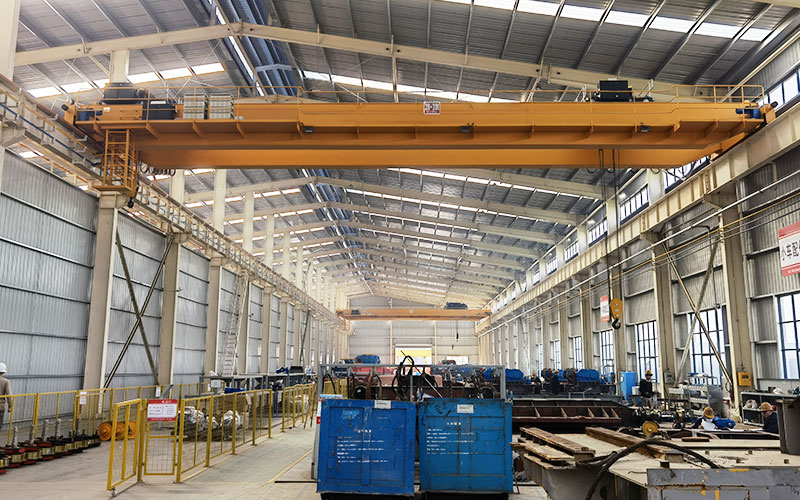
Moving Welded Assemblies Between Workstations
Welding often changes the weight and geometry of a steel component. A collection of individual beams may become a single welded frame weighing 20 or 30 tons.
At this stage, the component may no longer be practical to move with forklifts.
The overhead crane for sale provides a controlled transfer path between production stations.
A typical workflow could be:
Steel storage → cutting → fit-up → welding → inspection → surface treatment → finished-product storage
The crane can support the transfer between these stages wherever the runway covers the required area.
This is particularly valuable in long fabrication workshops. Instead of using trucks or mobile cranes to move components between bays, the overhead crane can perform the lifting and horizontal travel operation within its designated coverage.
Turning Large Steel Structures During Fabrication
Some steel assemblies need to be rotated during welding or inspection.
A fabricated box structure, frame, or large vessel-like component may need access to several sides. The lifting system must therefore be designed around the load’s center of gravity and approved lifting points.
For example, a 25-ton welded frame may initially rest horizontally. During fabrication, workers may need to rotate it to access the underside. This can require two lifting points or coordinated lifting equipment rather than simply attaching one hook to the center of the load.
The crane itself should not be assumed to perform every rotation operation automatically. The rigging arrangement, lifting points, load stability, and approved work procedure determine whether the operation is feasible.
For heavy fabrication, controlled lifting and positioning are generally more important than maximum lifting speed.
Supporting Steel Structure Assembly
Large steel structures are often assembled from multiple components.
A workshop may fabricate:
- Industrial platforms
- Steel frames
- Conveyor structures
- Storage systems
- Boiler structures
- Bridge components
- Machinery support frames
- Large welded housings
The crane can position each component into the assembly area.
For example, a 30-ton machine base may consist of several fabricated sections. The crane can place the sections on assembly fixtures while welders and fitters complete the connection work.
The benefit is not simply reducing manual labor. Controlled lifting also allows the workshop to organize large components within a defined production sequence.
Crane Use During Inspection and Quality Control
Heavy steel assemblies frequently require dimensional inspection, weld inspection, or non-destructive testing.
An assembly may need to be moved from the welding area to an inspection zone without being dismantled.
A 40 ton overhead crane can transfer the finished assembly while maintaining a clear floor path.
In some cases, the crane may also be used to position a component so inspectors can access specific surfaces. However, the load must remain securely supported throughout the inspection process, and personnel should not work beneath a suspended load.
This makes crane positioning capability an important part of workshop layout planning.
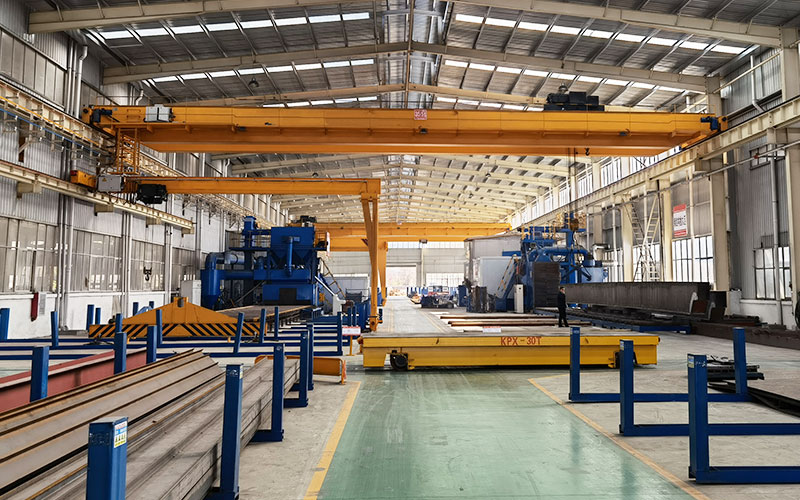
Loading Finished Steel Structures for Shipment
The final stage of fabrication may involve moving the completed structure to a truck, trailer, storage area, or dispatch zone.
This can be challenging when the finished product weighs tens of tons and has an irregular shape.
A 40 ton overhead crane can lift the structure from the final assembly area and position it for transportation.
For example, a fabricated steel frame weighing 32 tons may be lifted from the workshop floor and placed onto a heavy-duty trailer. The crane’s hook height must provide sufficient clearance for the trailer deck and rigging arrangement.
The crane runway must also extend far enough toward the loading zone. A crane with adequate capacity but insufficient travel coverage will not solve the actual material-handling problem.
Why Workshop Layout Matters
A 40 ton heavy duty overhead crane should be selected together with the workshop layout rather than as an isolated piece of equipment.
Important layout factors include:
Runway length: Determines how far the crane can travel longitudinally.
Crane span: Determines the width of the working area covered by the crane.
Hook approach: The distance between the hook and the building columns or end walls affects usable lifting coverage.
Lifting height: Must account for the tallest component, rigging, transport equipment, and required clearance.
Column spacing: Existing building columns can affect runway design and crane installation.
Production equipment: CNC cutting machines, welding stations, blasting equipment, painting areas, and storage racks must remain clear of crane travel and load paths.
A technically adequate crane can still provide poor productivity if its travel range does not match the actual material flow.
How Much Capacity Does a Steel Fabrication Workshop Need?
A 40 ton crane does not necessarily mean that the workshop routinely lifts 40-ton loads.
For example, a fabrication facility may handle:
- 5-ton steel plates
- 10-ton beams
- 15-ton welded frames
- 25-ton machine bases
- 32-ton structural assemblies
- Occasional 38-ton heavy components
A 40 ton crane can therefore provide a suitable capacity range if the actual maximum lifted load remains within the rated operating conditions.
However, the crane should not be selected simply by taking the heaviest component and assuming that capacity alone determines the specification.
The engineering review should consider the load weight, lifting accessories, lifting points, load geometry, frequency of operation, duty classification, and future production requirements.
If the workshop expects a future component weighing 45 tons, selecting a 40 ton crane based only on today’s 32-ton maximum load could create a capacity limitation later.
What Other Parameters Matter Besides 40 Tons?
For steel fabrication applications, several parameters have a direct impact on crane performance.
Lifting height: Determines whether large frames can be lifted above fixtures, transport equipment, and other obstacles.
Hoisting speed: Faster lifting can increase productivity, but precision is often more important when positioning large fabricated structures.
Crane travel speed: Determines how quickly components can move between production areas.
Trolley travel speed: Controls positioning along the bridge.
Duty classification: Reflects how frequently the crane operates and the load spectrum it handles.
Control system: Pendant, remote, or cabin control can be selected according to workshop layout and visibility requirements.
Power supply: The electrical system must match the workshop’s available power and crane configuration.
Lifting attachments: Hooks, spreader beams, clamps, slings, and other devices must be selected according to the actual loads.
When Is a 40 Ton Overhead Crane a Good Choice?
A 40 ton overhead crane is particularly suitable for steel fabrication workshops that repeatedly handle heavy components within a fixed production building.
It is a practical choice when the workshop requires:
- Heavy steel plate handling
- Large structural member positioning
- Welded assembly transfer
- Heavy fabrication and fit-up
- Component movement between production bays
- Finished structure loading
- Regular lifting over a defined runway area
It may be less suitable when lifting operations are highly irregular and occur across large outdoor areas with no fixed production route. In such situations, a gantry crane or mobile lifting solution may be more appropriate depending on the site requirements.
Frequently Asked Questions
What is a 40 ton overhead crane used for in steel fabrication?
It is used to lift and transfer heavy steel plates, beams, columns, welded frames, machine bases, structural assemblies, and finished steel products between fabrication, welding, inspection, storage, and loading areas.
Can a 40 ton overhead crane lift a 40 ton steel structure?
A 40 ton overhead crane is rated for a maximum lifting capacity of 40 tons under its specified operating conditions. The complete lifting arrangement, including applicable lifting accessories and the actual load configuration, must be considered before determining whether a particular 40-ton lift is permissible.
Why use an overhead crane instead of forklifts in steel fabrication?
Large steel structures can exceed forklift capacity or dimensions and may be difficult to maneuver safely with floor-based equipment. An overhead crane uses elevated runways, leaving much of the workshop floor available for production, vehicles, and storage.
What determines the required span of a 40 ton overhead crane?
The span is primarily determined by the width of the required lifting area and the building structure. The crane should provide adequate coverage while maintaining appropriate clearance from columns, equipment, walls, and other obstructions.
Is a 40 ton overhead crane suitable for heavy steel assembly?
Yes. It can be used to position beams, frames, machine bases, platforms, and other heavy assemblies during fit-up, welding, inspection, and finishing operations, provided the crane capacity and configuration match the actual load and workflow.
Conclusion
A 40 ton overhead crane in a steel fabrication workshop is fundamentally a material-flow system. It connects raw material storage, cutting, fit-up, welding, inspection, finishing, assembly, and dispatch by providing controlled lifting and horizontal movement across the workshop.
The most effective installation is not necessarily the crane with the highest lifting capacity or fastest speed. It is the crane whose capacity, span, lifting height, travel coverage, duty classification, and lifting equipment match the workshop’s actual production process.
For steel fabricators handling large structures and components on a regular basis, this approach can turn crane selection from a simple equipment purchase into a more efficient production-handling solution.