For busy yacht clubs, commercial boatyards, and municipal marinas, a mobile boat hoist—commonly referred to as a travel lift—is more than just a piece of heavy machinery. It is the operational backbone of the entire facility. Under high-traffic conditions, particularly during spring launch and autumn haul-out seasons, the efficiency, reliability, and safety of this equipment directly dictate the facility’s throughput, labor costs, and reputation.
A 100-ton travel lift represents a significant capital expenditure, typically expected to remain in active service for 15 to 20 years or more. Making the correct specification choices during the procurement phase is critical. This guide provides an objective, technically rigorous framework for yacht club managers, marina operators, and marine engineers to evaluate, specify, and select a 100 ton travel lift optimized for intensive daily operations.
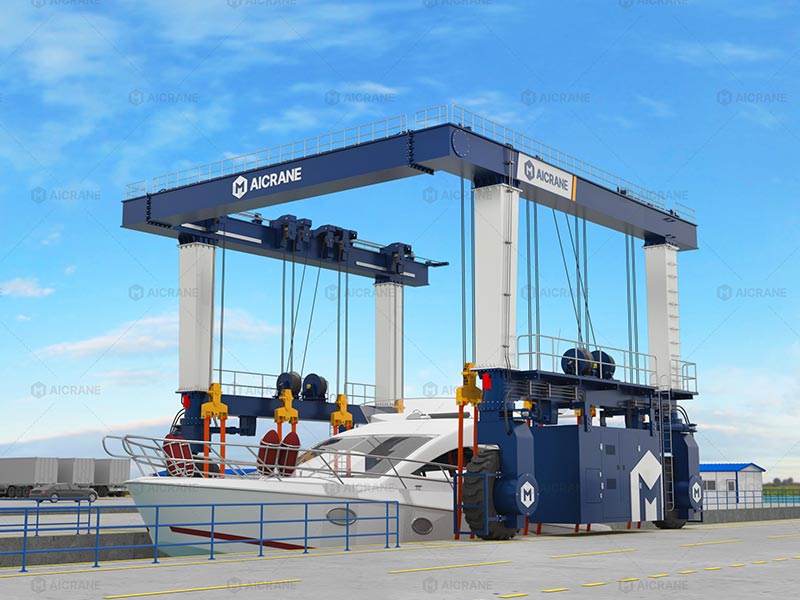
1. Defining the Operational Envelope: Beyond the Nominal Rating
The designation “100-ton” is a nominal capacity rating. In practice, selecting the right machine requires a granular understanding of your specific fleet distribution and how nominal capacity translates to safe working loads.
The Realities of Vessel Weight Displacements
A 100-metric ton capacity lift is designed to handle a maximum structural load of 100 tonnes under ideal conditions. However, experienced operators must account for several variables:
- Wet Weight versus Dry Weight: Manufacturer specifications for yachts usually state dry weight. When a vessel is hauled, it may carry several tons of fuel, fresh water, black water, provisions, and marine growth.
- The Safety Margin: For high-frequency lifting, running a machine consistently at 95% to 100% of its rated capacity accelerates component fatigue. A professional operation should aim to operate within a 15% to 20% safety buffer. This means a 100-ton lift is ideally suited for a fleet where the vast majority of vessels displace 85 tons or less.
Fleet Profile Assessment
Before finalizing dimensions, analyze the physical characteristics of the target fleet:
- Sailing Yachts: Require deep sling drops to clear deep keels, along with specialized sling placements to avoid damaging prop shafts, rudders, and transducers.
- Luxury Motor Yachts: Often feature wide beams, heavy stern concentrations (due to large engines and fuel tanks), and delicate hull projections (stabilizer fins, thrusters).
- Catamarans and Multi-Hulls: Demand exceptional inside clear width. A standard 100-ton lift may not accommodate the beam of a modern 60-foot cruising catamaran without custom structural widening.
2. Analyzing Structural Dimensions and Geometry
Sizing the physical frame of the boat travel lift for sale is a balancing act between the largest vessels you intend to service and the physical constraints of your yard, piers, and travel routes.
Inside Clear Width (ICW)
The inside clear width is the most critical structural dimension. While increasing the width of the machine allows you to lift wider vessels (such as catamarans and modern wide-beam motor yachts), it also:
- Increases the structural bending moments on the upper cross beams, requiring heavier steel profiles.
- Requires wider launching slips, which can be highly expensive to modify or construct.
- Reduces maneuverability within tight dry-docking storage lanes.
For a standard 100-ton lift, an ICW of approximately 8.5 meters (28 feet) to 10 meters (33 feet) is typical. If your facility services a high volume of catamarans, a custom wide-span configuration may be required, but this must be balanced against the bearing capacity and width of your existing concrete piers.
Hook Height and Clear Height
The total height of the machine must allow the deepest-draft vessel in your target fleet to clear the dock wall at high tide, traverse over yard obstacles (such as jack stands or cradles), and navigate sloped washdown pads.
To calculate the required height, use this basic formula:
Required Height = Draft of Deepest Vessel + Yard Obstacle Height + Sling Thickness + Safety Clearance (minimum of 0.5 meters)
Additionally, ensure that the overall height of the machine does not conflict with overhead utility lines, facility door lintels, or local zoning height restrictions.
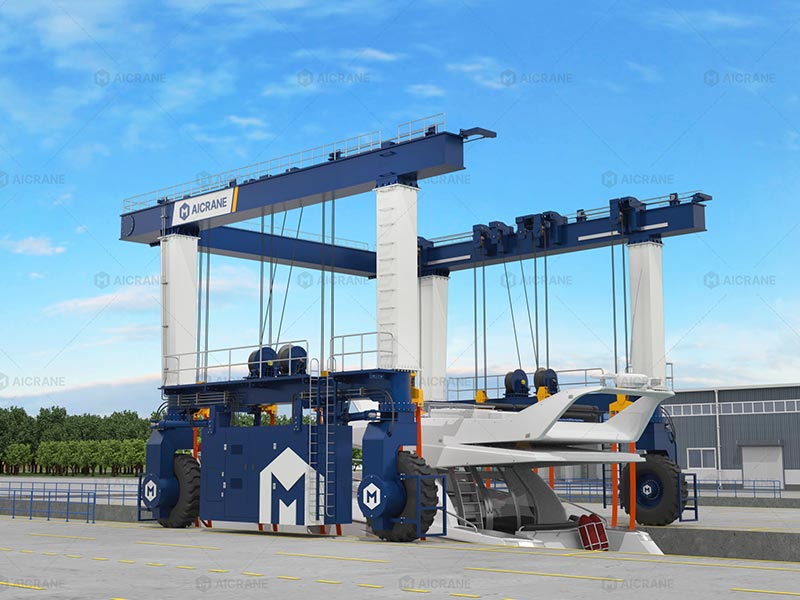
3. Selecting the Steering Configuration for Yard Optimization
Maneuverability is the primary driver of yard space utilization. The choice of steering system directly impacts how tightly vessels can be parked, reducing wasted space and increasing the revenue-generating capacity of your hardstand.
| Steering Mode | Description | Ideal Use Case | Yard Space Impact |
|---|---|---|---|
| Two-Wheel Steering | Only the front or rear pivot wheels turn. Standard automotive-style turning. | Open yards with straight, wide transit lanes. | Requires large turning radiuses; low storage density. |
| Four-Wheel / Coordinated | All four wheels turn in opposing directions to minimize turning radius. | Medium-density yards with defined corners. | Moderate turning radius; improved positioning speed. |
| Crab Steering | All wheels turn in the same direction, allowing diagonal or lateral movement. | High-traffic, highly congested yards. | Excellent. Allows side-shifting of vessels into tight parking slots without pivoting. |
| Carousel / Pivot | Wheels turn perpendicular, allowing the machine to rotate 360° around its center. | Extremely tight spaces, dead-ends, and perpendicular slip entries. | Maximum. Virtually eliminates the need for wide turning sweeps. |
For high-traffic operations, investing in an electro-hydraulic multi-mode steering system (including Crab and Carousel modes) pays dividends in labor savings and maximized square footage.
4. Hydraulic and Drive System Engineering
The duty cycle of a travel lift or mobile boat hoist determines the engineering standards required for its internal systems. In a high-traffic environment, a travel lift may perform 15 to 30 lifts per day, operating continuously for several hours.
Closed-Loop versus Open-Loop Hydraulics
- Closed-Loop Systems: Typically offer smoother control, higher thermal efficiency, and better deceleration control. They are highly recommended for heavy-duty cycles because they generate less heat, preserving hydraulic fluid life and reducing seal wear.
- Open-Loop Systems: Simpler and less expensive to maintain, but they can run hotter under continuous, back-to-back lifting cycles. If selecting an open-loop system, ensure an oversized industrial oil cooler is specified.
Winch and Wire Rope Configuration
- Independent Hoisting Winches: The lift should feature four independent winches (two per side) with proportional control. This allows the operator to adjust the level of the vessel dynamically if the weight distribution is biased toward the bow or stern.
- Wire Rope Safety Factor: Insist on wire ropes and sheaves designed to a minimum safety factor of 5:1 relative to the maximum working load. Grade 316 stainless steel or specialized compacted galvanized ropes with marine-grade lubrication are necessary to prevent corrosion-induced failure.
5. Control Systems: Precision and Ergonomics
In high-traffic yards, operator fatigue is a major contributor to minor accidents, such as hull scrapes or collision with stanchions. The control interface should mitigate this risk.
Wireless Remote Control
A high-quality, industrial-grade proportional wireless remote control is mandatory for modern operations.
- Safety Advantage: It allows the operator to walk around the machine, maintaining a direct line of sight to critical clearances (such as the clearance between the keel and the dock wall, or sling alignment on the hull).
- Redundancy: Ensure the machine also features a fully functional, hardwired backup control panel on the chassis or inside a protected cabin. This prevents yard downtime if the remote transmitter is dropped or experiences battery failure.
Cabin versus Ground Operation
While wireless remotes are ideal for close-quarters maneuvering, an enclosed, climate-controlled operator’s cabin can be beneficial in regions with extreme weather (extreme heat, freezing winter hauls). If a cabin is selected, it must be positioned to offer maximum visibility of both the hoist wells and the travel path, supplemented by marine-grade CCTV cameras.
6. Crucial Safety Systems for High-Traffic Environments
High throughput should never compromise safety. When evaluating manufacturers, verify compliance with international standards such as EN 15011, ASME B30.2, or equivalent local regulatory frameworks.
- Electronic Load Weighing Systems: The hoist must feature real-time load cells on each winch. The control screen should display the individual weight at each hoist point as well as the cumulative weight. This prevents structural overload and alerts the operator to dangerous center-of-gravity shifts.
- Overload Protection Limit Switches: Automated systems must cut off hoisting functions if the load exceeds 110% of rated capacity, or if severe load imbalance occurs between the port and starboard sides.
- Two-Stage Limit Switches: Prevent “two-blocking” (the dangerous condition where the hook block collides with the upper sheave assembly).
- Wind Speed Anemometers: High-profile vessels act as sails. Integrated wind-speed sensors should trigger audible and visual warnings when wind speeds exceed safe operational limits (typically 15 m/s, or about 30 knots).
- Emergency Stop (E-Stop) Architecture: E-stop buttons must be highly visible and located at all four corners of the machine’s lower structure, as well as on the remote control transmitter.
7. Analyzing Total Cost of Ownership (TCO) and Lifecycle Support
The initial purchase price of a 100-ton travel lift represents only a portion of its true lifetime cost. A low-cost machine that suffers frequent hydraulic leaks or has poor parts availability will quickly become an expensive operational liability.
Key Factors in TCO Calculation:
- Structural Coating: Marine environments are highly corrosive. Look for hot-dip galvanized components, or a marine-grade three-coat epoxy paint system with a minimum dry film thickness of 250-300 μm. Poor paint specifications lead to structural rust within 5 years.
- Engine Selection: Specify Tier 4 Final / Stage V compliant diesel engines from global manufacturers (such as Cummins, Caterpillar, or Volvo Penta). This ensures local mechanics can easily access diagnostic tools, filters, and spare parts.
- Support Agreements: Prioritize manufacturers who offer remote diagnostic capabilities via cellular telemetry modules. If a sensor fails, factory technicians should be able to log in remotely to diagnose the fault, minimizing diagnostic downtime.
Conclusion: Strategic Purchasing Questions
When requesting proposals for a 100-ton mobile boat hoist, do not rely solely on standard brochures. Ask Aicrane these direct, operationally-focused questions:
- What is the continuous duty cycle rating of the hydraulic system at 35°C ambient temperature?
- Can the sling spacing be adjusted hydraulically from the remote control while under load, or does it require manual adjustment?
- What specific structural steel grade is used, and what is the design safety coefficient of the main frame?
- What is the estimated delivery time for critical replacement parts (such as hydraulic pumps or wheel motors) to our region?
- Does the control system log telemetry data and fault codes for preventative maintenance tracking?
By focusing on physical dimensions, steering flexibility, hydraulic duty cycles, and robust product support, yacht club and marina managers can secure an asset that optimizes yard space, enhances operational safety, and delivers reliable service for decades to come.